

Resist the Landfill Economy: How to Fight e-Waste
April 21, 2026 · Jeffrey C. Dunnihoo
A version of this article appeared in the Spring 2025 SEA Homeschoolers Magazine
By choosing durable devices, repairing instead of replacing, and slowing the upgrade cycle, families can significantly reduce their e-waste footprint and push back against planned obsolescence. Don't litter the world with dead laptops, old washing machines and...protest signs that don't address the real problems!

Electronic e-Waste Management Starts at Home
Every smartphone, laptop, and tablet links us to mineral mines in Africa, factory workers in Asia, and landfills throughout America and the world. But between consumption and the consequences, can a single consumer truly make a dent in the mineral extraction scarring landscapes, the modern slavery powering production lines, the mounting e-waste crisis, and the carbon footprint that follows each device from manufacturing to disposal? And what is the economic opportunity cost of constant device upgrades, moving factory output quickly into the landfill, on a high interest rate payment plan, no less!?
Unboxing a new smartphone may evoke a space-age technology rush, but it is also tainted by the reality of 21st century slave labor mining many of the raw materials and the assembly of the device by dormitory bound workers. These young “modern slaves” in Africa and Asia who so much resemble the Dickensian past of the Industrial Revolution are the same human beings who loaded the space-age technology into that “recycled material” box. [Kara 2023]
Since the days of the “Foxconn Suicides,” we now have “Modern Slavery” laws and corporate position statements, and even international manufacturing standards like ISO37200 in development to prove the company paid attention to issues like slavery, but not about the churning sales of new devices that drives our “Landfill Economy.” [Horlock 2025]
The consumer demand for faster and cheaper can only drive the reliability of the device and the labor to produce them in one direction. Grappling with this problem at the personal level may seem overwhelming, especially to young students fascinated with technology but who also care about their future and the future of the environment. And we can all make a difference not through violent protests or legislating mandates, but by addressing the entire problem at the “buy” button in our own lives: valuing “slower and durable” over “faster and cheaper.” We can shop for long-lasting devices instead of frequent upgrades.
In fact, families can take such actions at home, right now. Public and private institutions with dedicated IT budgets for students or employees often suffer from the “use it or lose it” dilemma. But families in their home have the flexibility to choose to reuse devices, re-install a new Linux operating system on an older laptop, or even leverage the repair of a cellphone as a learning opportunity, whereas this would be intractable in a large school environment.
Kids are constantly exposed to the cognitive dissonance of being told on the one hand about environmental responsibility, and then handed “free” new laptops at school donated by companies who hope to soon capture these students as customers of the Landfill Economy.
Simpler resources like paper and glass can often be recycled effectively. But extracting raw materials from electronic products in particular is extremely difficult because of their tightly integrated nature. The more compact and elegant the design, the harder it can be to recycle. Of the small percentage of material that is recycled, the raw materials may then be used in very low-value products that are unlikely to be recycled again. [Horlock 2025] Which is why the goal of a cyclical recycling economy in electronics has become the Landfill Economy in reality.
The problem of e-waste is a growing global issue that has significant economic and environmental impacts approaching 100 million tons and trillions of dollars annually. With the rapid growth in electronic product sales volume, the amount of heavy metals, toxic flame retardants, PVC and plastics in the e-waste generated is also increasing, causing harm to the environment and human health.
The obvious solution is staring us in the face
If you can avoid upgrading every time you desire a new iPhone and simply replace a device half as often you can cut your entire footprint for that function in half! Or buy a used device with more serviceable and available displays and batteries. Replaceable advanced technology batteries are more compatible with recycling than tightly integrated ones glued in a non-repairable unitized phone.
Warranties might appear to imply a reliability lifespan, but they merely amortize the expected mean time to failure and ensure a complete replacement cycle. We shop on price. We compare on features. We buy because the old phone is looking rough...but very few consumer decisions are made primarily based on product lifetime and durability, especially when the expected replacement cycle is only a year or so.
Dampening demand for faster cycle times is the only market driven way to compel corporations to stem the flow of e-waste flooding the planet, and provide margins that reduce the demand for modern slave wages. The environment need not be sacrificed on the altar of consumerism. Changing the upgrade culture can only begin at the individual decision to repair, not replace; to seek sensible reliability, not impulsive features.
Reliability vs. Planned Obsolescence
By intention or not, shorter product lifespans can obviously sell more units than more durable designs, but robust designs cost more. Contrast a cheap toy drone conking out in a light rain against the Voyager 1 & 2 spacecraft which are still operating in the harshness of interstellar space almost 50 years, beyond their 5 year mission target. Whether in aerospace, automotive, or the consumer area, engineers must always optimize a complex gamut of performance, robustness and price. [Dunnihoo 2015]
Engineers design for a product life cycle around what we call the “Bathtub Curve” which predicts early product “infant mortality” and eventual lifetime device “wear-out.” (See Figure ) A tablet or a smartphone may contain thousands of components and connectors. Some of those will contain latent defects which will fail early in the “infant mortality” phase. Thermal and electrical overstress like SOIC and SOT are exposed to in my children’s book series will eventually break down some components in the wear-out phase. Yes, solid state semiconductors actually wear out with use! Advanced semiconductors today can have lifetime expectations of only a couple of years as compared to less tightly integrated discrete consumer electronics that, like Voyager aerospace quality, could operate for decades beyond their design targets.
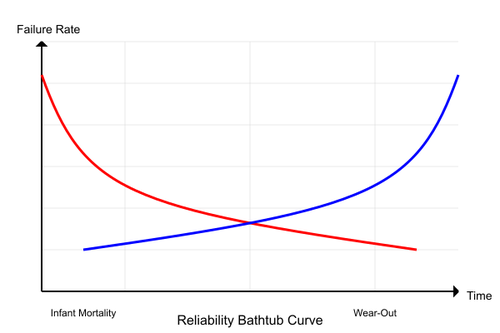
Manufacturers may perform burn-in or accelerated stress tests to catch early life failures before they are shipped to the user. Other design techniques can be used to delay the onset of the wear-out curve. Designers used to anticipate and encourage component repair, even provide schematic drawings and part-lists inside the product. We must return to this model. Even the imagined utopias of Star Trek and Star Wars assume that mechanics would still be around trying to keep their starships and used droids running with parts from junk dealers!
We don’t yet need a washing machine or a laptop to go to Mars (well, we may soon, anyway,) but is it really acceptable to have a computer-controlled “ultra-efficient” washer-dryer destroyed because of a computer board built to the low robustness standards of a toy?
Right to Repair Movement
One of the most well known life cycle “innovations” is the inkjet and laser printer cartridge designs that inhibit users from using aftermarket cartridges or refill options. Given that laser toner is a possible carcinogen, there are good reasons to discourage users from messing with the loose powder. But the market trend to sell a cheap printer with expensive consumables is primarily a business model decision, not safety. Originally created to prohibit hacking of encrypted movies and other IP, the Digital Millennium Copyright Act (DMCA) has been stretched to prevent people from repairing their own devices. Large companies from Apple to John Deere can rely on the DMCA to prevent users from repairing devices with encrypted firmware, for example, instead of buying new ones. This then requires users to pursue OEM-only parts that are not available or cost-effective for repair. Violating the DMCA by using aftermarket parts can carry the threat of a federal felony. [Ashoka 2024]
A Call to Inaction?
We have the power to make decisions to NOT buy, and we can choose to DELAY consumption. We can make smart choices that can help guide the market to reduce e-waste and its negative impact on our planet. Every time we reach for a new gadget, we should think about where it came from and what happens to our old devices. Choosing products that last longer is not just a better option for our wallets; it’s also better for the environment and the people involved in making these devices.
Before you decide to upgrade to the newest smartphone or tablet, ask yourself a few important questions: Do I really need a new device right now? Would a refurbished or used device do the job just as well? By opting for longer-lasting products or even repairing what we already have, we can lessen the demand for new electronics and help reduce waste.
Let’s also get involved in the conversation about the "right to repair." Support the idea that we should be able to fix our devices instead of just tossing them out when they break. Talk to your friends and family about the importance of making responsible choices and spreading the word about the impact of e-waste. By changing our habits and choosing wisely, we can make a big difference from the ground up.
References
- Kara, S. (2023). Cobalt Red: How the Blood of the Congo Powers Our Lives. St. Martin's Press. Referenced in NPR. https://www.npr.org/sections/goatsandsoda/2023/02/01/1152893248/red-cobalt-congo-drc-mining-siddharth-kara
- Horlock, D. (2025, February 11). Tackling modern slavery in global supply chains. Hinrich Foundation. https://www.hinrichfoundation.com/research/article/sustainable/tackling-modern-slavery-in-global-supply-chains/
- Lee, J., et al. (2024, August 15). Environmental and economic impacts of e-waste recycling: A systematic review. Chemical Engineering Journal, 494. https://www.sciencedirect.com/science/article/abs/pii/S1385894724044048
- Ashoka. (2024, June 18). The power of repair: Tackling the throwaway economy. Forbes. https://www.forbes.com/sites/ashoka/2024/06/18/the-power-of-repair-tackling-the-throwaway-economy/
- Dunnihoo, J. (2015). Co-Design Gamut. In C. Duvvury & H. Gossner (Eds.), System Level ESD Co-Design (Ch. 10). IEEE Press.