

How to Turn a Robot Kit Into a Real Engineering Experience
Programmers call it a “Hello world!” program. In any new programming language, you need to have the basics of the compiler or interpreter, loader, input/output basics* to see if everything works, and we do something silly like print “Hello world!” *Literally, for some of us, it was BASIC.
There is a similar kind of magic that happens when a child's toy robot project moves for the first time under their own control. Something they wired, something they programmed, however basic, lurches across the kitchen floor and they look up with an expression that is equal parts shock and ownership.
I've been in the electronics industry for forty years. I started in Arlington, Texas at a small computer manufacturer for summer work when I was 13 or 14. My job was to place components with 3-4 adults listening to The Police, Rush and, admittedly, even Journey on the assembly line (it was the early 80s, what can a kid do?)
From there, my job was to catch the boards coming hot out of the 60/40 lead solder reflow line with asbestos gloves, carry them in a basket into a room with a pressure washer vat of trichlorotrifluoroethane (and no ventilation) and then let them cool for funtional testing. Soon I moved from the "cancer machine" to the debug bench fixing solder bridges and bad components.
That job probably took 10 years off my life, but it was truly formative. If I had happened to be doing that same work at the same time in a small garage in Palo Alto with Steve and Woz, things might have turned out quite a bit different, who knows! After college I co-op’d with IBM where the official “full-employment” commitment was ended the year after I started. (Yes, there once was a time when corporations were loyal to their employees! But I digress...) Was hired out of there by a semiconductor company, moved to a more specialized chip company, learning more and more about less and less until I became a consultant. An ideal consultant is a person who has learned so much about such a narrow field that they essentially know everything about nothing.
But working in the industry from Austin to Asia, Hong Kong to Hamburg, Portland to Boca Raton, I’ve seen decades new designs, manufacturing lines, supply chains, and failure analysis. But throughout, I have seen so many adult engineers with that same expression on a kid's face when the robot lurches forward like Dr. Frankenstein’s creation!
But, I have also sat in meetings where there were more lawyers and executives than engineers who argued about derating curves and functional specification errata and approved vendor lists, and millions of dollars per day of liability for mistakes.
When an assembly line stops, dollars start evaporating into thin air!
The child’s innate engineer enthusiasm is real. It's imperative that we encourage it. And it's necessary to build on it, because the fun in the way that hard things are fun is in fact the best preparation for what engineering actually is.
The jump from "builder" to "engineer" isn't about buying a harder kit. It's about holding both ends of the design cycle: the launch and the returns. Just like the rocket science it is.
Here are some observations and suggestions to help expand a mere robot club to a real junior engineer launchpad:
1. Ask "How Will It Fail?" Before You Ask "How Do We Build It?"
Most school projects — most kits, most maker activities — are graded or evaluated on a single criterion: does it work? The robot moves, the LED lights up, the sensor detects the hand wave. Success. A+ Chicken Dinner. On to the next activity.
This is, from an engineering standpoint, almost perfectly backwards.
In professional practice, one of the most important documents on any project is something called a Failure Mode and Effects Analysis (FMEA.) Before anything gets built, the team systematically lists everything that could go wrong, estimates how likely each failure is, assesses how bad the consequence would be, and decides what to do about it. It is not a pessimistic exercise. It is one of the most rigorous and clarifying things an engineering team can do, because it forces honesty about assumptions before those assumptions are cast in solder and shipped to a customer. [Murphy reference]
Anything that can go wrong will go wrong.
You don't need a formal FMEA process to introduce this thinking to a kid. You just need to ask, before the build starts: "Name ten ways this could fail."
Kids, it turns out, are remarkably good at this. They have magnificent imaginations for disaster. Let them use it. Then take it one step further: "Which of those failures would be annoying? Which would be actually bad? Which would be dangerous?"
That ranking exercise, consequence severity, in the formal vocabulary, is systems thinking. It's engineering judgment. And it reframes the entire build from "make it work" to "make it work reliably, for the right reasons, under the conditions it will actually face." That's a completely different mindset, and it transfers. Oh, and do it for cheap.
2. Add Real Constraints Before They Start Building
Hand a child a robot kit and say "build a robot" and you'll get a robot. Hand them the same kit and say:
"You have $10 of budget left for any additional parts. It has to survive being dropped from waist height twice. It has to run for three hours on one charge. It has to work in the garage in January."
Now you have engineering.
Constraints are not punishments. They are the actual definition of the problem. Every engineered thing that exists in the world, every bridge, every phone, every medical device, was built inside a set of constraints that shaped every decision its designers made. Compromise. Weight. Cost. Power consumption. Optimize. Operating temperature. Regulatory requirements. Manufacturing tolerances.
"It would be well if engineering were less generally thought of...as the art of constructing. ...it is the art of doing that well with one dollar, which any bungler can do with two...."
Without constraints, you are not engineering anything.
What a child discovers almost immediately under real constraints is that you cannot optimize for everything simultaneously. A design that runs longer on one charge may move more slowly. A design that survives drops may cost more. A design that works in the cold may need a different battery chemistry. These are not abstract lessons from a textbook. They are the actual texture of every design decision every working engineer makes every day.
Start simple. Add one constraint. Watch what happens to the thinking.
3. Introduce the Concept of Margin
Ask a child why a bridge that carries cars is built to hold far more weight than any realistic traffic load. They'll usually get to the right answer: because something could go wrong, and you want room for that.
That room has a name in engineering: margin. And it is one of the most important concepts in the discipline.
Margin is the gap between what a system is designed to do and the limit at which it breaks. It is not waste or timidity. It is the quantified acknowledgment that the real world is variable, that manufacturing isn't perfect, that environments aren't controlled, that components age, that users do unexpected things, and that your calculations, however careful, have assumptions baked into them.
Your robot kit's motor is rated for 6 volts absolute maximum rating at no load. You're running it at 5 volts under a heavy load. What's the margin? What happens as the battery drains and the voltage drops toward 4.5 volts? Does the robot still work? Does it work differently? Does it get hot? Can it catch on fire? At what point does "works differently" become "doesn't work" or “burned the house down?”
These are not rhetorical questions. They are the exact questions an engineer asks, and they have real, testable, observable answers that a kid with a multimeter and some challenging can begin to explore.
The extension of this is asking about aging. A battery that delivers full capacity on day one delivers less on day two hundred. A motor that turns freely when new develops more friction as it wears. A sensor that reads accurately at room temperature reads differently at 5°C and differently again at 40°C. Margin is the engineering response to all of these realities.
Once a kid hears about margin, accuracy and precision, they start looking at everything differently. Why is the recommended maximum current for that wire lower than its theoretical melting current? Margin. Why does the power supply output 5.1 volts instead of exactly 5? Tolerance and margin. Why does another meter show the same power supply to be 4.97 volts? Accuracy and precision, Why does the bridge have that much extra capacity? Because the engineer who designed it was thinking about things that hadn't happened yet.
That is engineering foresight. It can be introduced with a robot kit and a simple question: "What happens at the edges?"
4. Take Something Broken Apart — Then Ask Why
Here is an underused resource available in almost every home: broken things.
Dead toys. Failed appliances. Old electronics that stopped working. These are not trash. They are, for an engineering-curious mind, one of the richest educational materials available. Take one apart. If not to fix it. To read it. A broken appliance is an archaeological dig site of engineering.
What you're doing has a formal name in industry: failure analysis. When a product fails in the field, when something comes back from a customer (rather than one that failed right after it came out of the "tricho" bath) engineers examine it with the specific goal of understanding not just what broke, but why, and what that implies about the design, the manufacturing process, or the operating conditions. Oh, and the lawyers and executives will want to know whose fault it was, btw.
With a kid, the questions don't need to be that strict. They just need to be curious:
- Why did the designer make it this way instead of another way?
- What tradeoffs are visible in how it's built? (Why plastic here but metal there? Why one big capacitor instead of several smaller ones?)
- Where did the failure actually happen?
- Could you see the failure coming, in hindsight?
- What would you change?
The last question is the most important one. Because a child who looks at a failed design and says "I would have put the connector somewhere it couldn't get bent" has just done engineering. They've observed a failure mode, reasoned about a design alternative, and proposed an improvement. That process, observe, analyze, improve,is the core loop of the entire discipline.
The rule in professional failure analysis is that the component that actually failed is often not the root cause. The root cause is usually a design decision or tradeoff, a material choice, or a process step that created conditions in which that component was always going to fail eventually. Teaching kids to look past the obvious broken part to the upstream decision that enabled the failure is sophisticated thinking, and it's entirely accessible with a screwdriver and a dead toy or laptop.
5. Ask the Scale Question
This is the single most powerful engineering thought experiment I know, and it requires no equipment, no parts, and about sixty seconds.
Wait until the robot is working. Let the kid enjoy it. Then ask:
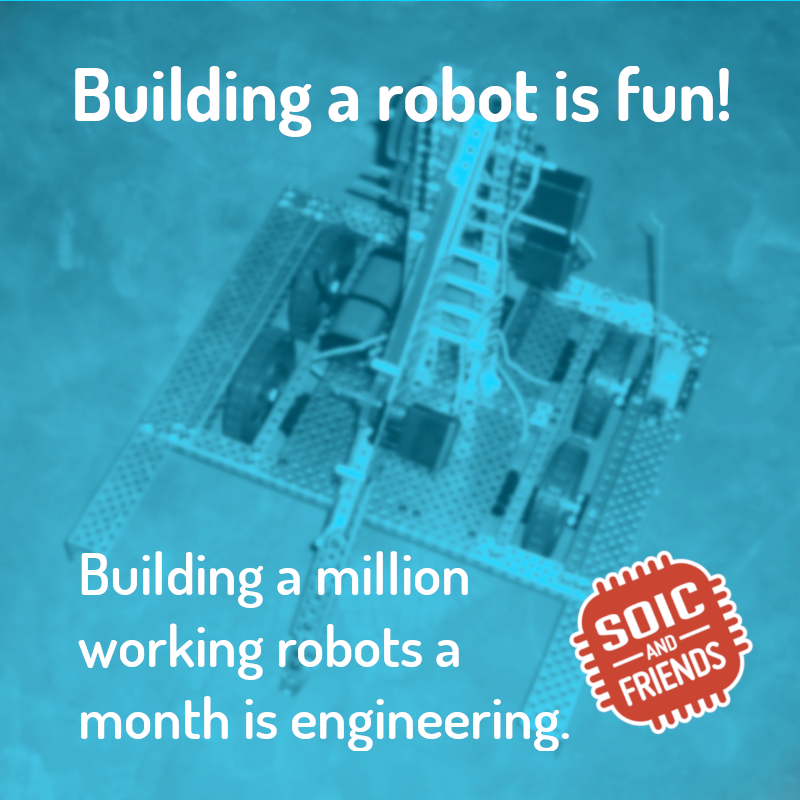
"This robot works. Great. Now imagine you have to make a thousand of them — all identical, all working — by next month. What do you need to do?"
Then stop talking and listen.
What emerges from this question, almost without fail, is the spontaneous rediscovery of some of the most important problems in manufacturing engineering. The kid who had to tweak the code to match their specific motors might notice: every motor is a little different, so every robot might need different tweaking, but at a thousand units, you can't do that by hand. The kid who glued a wheel back on might notice: I need to find better wheels. The kid who had to charge the battery constantly: I need more capacity or more efficiency.
What they'll discover, without knowing it’s learning, is manufacturing variation, process control, and the difference between a working prototype and a manufacturable design. These are real engineering problems that entire careers are built around solving.
You can extend this further with another question: "Now imagine some of those thousand robots get returned by unhappy customers. How do you figure out what went wrong?"
Now they're thinking about field failure analysis, customer feedback loops, and product improvement cycles. All from a kit robot on the kitchen floor.
Scale is the stress test of every design assumption. Even as a thought experiment, it forces honest reckoning with what was genuinely engineered versus what was accidentally correct.
6. Tell the Story Before You Show the Formula
The mathematics underlying electronics and mechanical systems are not abstract. They are descriptions of things that are physically happening, right in front of you, that you can see and measure and touch.
The problem is that math education frequently presents the formula first and the physical meaning somewhere. Many of the pioneers of those very equations started with the measurements and then discovered the equations.
If it was good enough for Faraday, Ohm, Ampère, Volta, Coulomb...you get the picture.
The LED burned out because too much current flowed through it. That's Ohm's Law V = IxR in physical, consequential form. The motor controller got hot because electrical power was being converted to heat. That's P = I x V as something you can feel with your hand. The robot slowed down as the battery drained because voltage dropped and the motor couldn't pull as much current. That's the relationship between power, voltage, and mechanical output, visible in real time.
Every formula that governs the behavior of an electronic or mechanical system has a story. The story is almost always more interesting than the formula, and once a kid knows the story, the formula becomes a tool for understanding and predicting rather than an obstacle to memorize.
This matters because one of the core skills of engineering is being able to look at a system, reason from first principles about what should happen, and then test whether the reality matches the prediction. That skill is built by habitually connecting mathematical and modeling relationships to physical experience, not by running a bunch of simulations of assumptions.
Ask: "The battery voltage dropped half a volt. What do you think that did to the motor speed? Let's measure and find out. Wait, how should we measure all of this..."
Skepticism, hypothesis, test, observation, is the scientific method. When you apply those principles to everyday, real problems, it is engineering.
And it can happen right there on the kitchen floor.
What These Things Have in Common
None of them require a different kit. None of them require a more expensive program, a specialized facility, or a teacher with an engineering degree. They require a different conversation, one that treats the kit as the starting point of a question rather than the answer to one.
When kids engage with these questions, something may shift in how they relate to the physical world. They may start noticing design decisions in everyday objects. They may start asking why things are built the way they are, and why they cost so much, or don’t last very long. They start being appropriately skeptical when something seems too simple because they've learned that simplicity on the surface usually means complexity underneath.
They start, in other words, thinking like engineers.
Engineering that keeps infrastructure working and medical devices reliable and aircraft in the sky is one of the most consequential human activities there is in this technical world. It deserves an introduction that's honest about what makes it both demanding and deeply satisfying.
The robot kit is a fine door into that world. Ask the kids to open the door.

TSSOP is always ready for an ESD surprise!