

A Lesson in Thermodynamics
Stay Cool with MSOP and DPAK!
If you've read the book, you will remember how DPAK got really hot on that scorching day. That wasn't just a made up problem, it's something that happens inside your tablet, phone, and laptop every single day!
Electronic chips like DPAK generate heat whenever they do their job. If that heat isn't moved away fast enough, chips can be permanently damaged. Most chips start to fail above 125°C (257°F) That's enough to boil water! That's why heroes like MSOP and Thermy cut off power before things get too dangerous.
Power, Heat, and Efficiency
Think of electricity like water flowing through a garden hose.
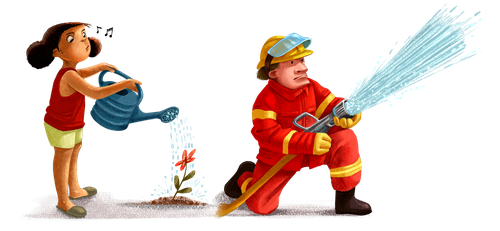
- Voltage is like the pressure pushing the water
- Current is like how much water flows through
- Resistance is like a kink in the hose slowing things down
Back in 1827, a scientist named Georg Ohm figured out a rule we still use today:
Voltage = Current x Resistance
Power (Watts) = Voltage (Volts) x Current (Amps)
Electronics turn power into useful things — games, music, light — but they always waste some power as heat. How much gets wasted tells us how efficient a device is.
| Device | Useful Output | Wasted As |
|---|---|---|
| Electric blanket | Heat (on purpose!) | Very little waste |
| Light bulb | Light | A lot of heat |
| Microchip | Running your game | Heat inside the case Turn on the fan! |
Think about it: Can you name other things around your home that get warm when they're working?
Three Ways Heat Moves Around
Heat never stays in one place — it's always trying to travel! There are three ways it does this:
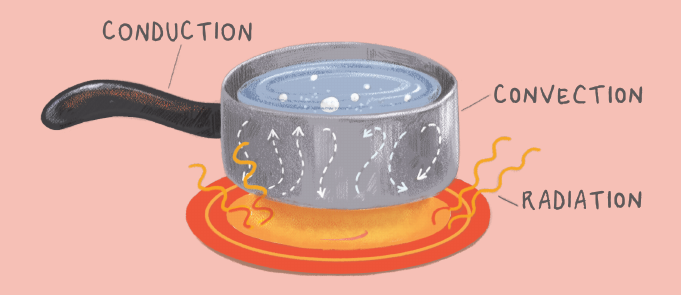
Conduction — Heat flows directly through and between solid objects. Touch a metal spoon sitting in a hot bowl of soup and you'll feel conduction instantly. Ouch!
Convection — Hot and cold fluids (liquids or gases) mix and carry heat along for the ride. A fan blowing air over a hot chip is convection in action.
Radiation — Heat travels as invisible waves of light, even through empty space. This is how the sun warms the Earth from 150 million kilometers away, and how you feel the warmth of a campfire without touching it.
REMEMBER!! Thermal radiation is completely different from ionizing nuclear radiation. It's just infrared light & perfectly safe and happening all around us!
Thermal Resistance: Your Jacket and DPAK's Lead Frame
Just like a wire resists electricity, materials can resist the flow of heat. Engineers call this thermal resistance.
- Your winter jacket has high thermal resistance — it slows heat from escaping your body, keeping you warm
- A swimming pool has low thermal resistance — it quickly pulls heat away from your skin, keeping you cool
Inside a chip like DPAK, the plastic body acts like a coat (high thermal resistance, protective), while the copper lead frame acts like a heat sink, pulling heat away quickly, like jumping into that pool.
Engineers add fans and metal heat sinks to devices to force heat away from chips before temperatures get dangerous.
Why Heat Can Break Things
When objects get hot, they expand just a tiny bit. When they cool down, they shrink again. Do this thousands of times and tiny cracks can form, just like how a road develops potholes over many winters.
This is why your phone might freeze up on a hot afternoon or act glitchy in the cold. A microscopic crack is opening and closing like a tiny secret switch!
To protect against this, engineers build in thermal limits that automatically turn on a fan or shut the device down before damage happens. It's better to lose your progress in a game than to lose the whole device forever!
The Thermal Engineers' Checklist
Next time a device feels warm in your hands, a thermal engineer already thought about that! They asked:
- How much heat will this chip create?
- How will we move that heat away?
- What happens if it gets too hot?
- How do we protect the chip automatically?
The next time your device quietly shuts itself off before overheating thank a thermal engineer, just like MSOP and DPAK do!
Try It at Home
- Hold a metal spoon and a wooden spoon. Which feels colder, even though they're the same temperature? That's conduction!
- Watch steam rise from a hot drink. That moving air is convection!
- Sit near (but not too close to!) a lamp or fireplace and feel the warmth without touching. That's radiation!
National Thermal Engineer Day is July 24!
In celebration of July 24th, Jeff Dunnihoo of Pragma Media sits down with Dr. Kaveh Azar — founder of Advanced Thermal Solutions, creator of Electronics Cooling magazine, and the engineer behind National Thermal Engineer Day — to talk about why thermal engineering matters more than most people realize.
From bank transfer errors caused by overheating chips to misread x-rays caused by electronic bit errors, Dr. Azar breaks down the hidden but critical role thermal engineers play in keeping our technology — and our lives — running safely and reliably.
They also discuss the launch of MSOP and DPAK: One Hot Day, Pragma Media's new children's picture book that introduces kids ages 2–6 to the real physics of electronics and thermal management through fun, colorful characters living inside a laptop.
Learn more about Advanced Thermal Solutions at qats.com

MSOP and DPAK - One Hot Day
MSOP is a power supply monitor chip in a laptop who manages “DEEPAK,” a powerful regulator chip. It’s a hot day “doing homework,” but will the mean old CPU give the microchips a break to cool off?